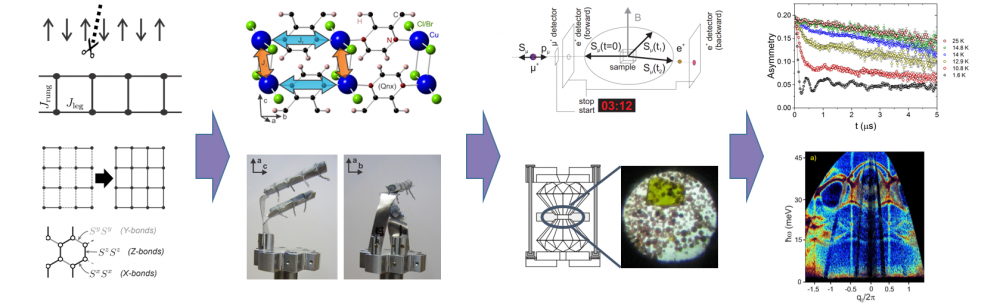
Quantum spin ladders are special models that provide a unique bridge between one- and two-dimensional magnetism, serving as ideal laboratories to explore the emergent quantum phenomena of many-body systems. In these systems, the magnetic behavior is governed by just two short-range interaction parameters, yet the resulting physics is intrinsically collective and can be remarkably complex.
Recently, we realized that a coordination compound Cu-CPA hosts two distinct spin ladders. Now using neutron spectroscopy, we learned that remarkably, both of them lie close to a rare and intriguing regime — the isotropic case, between the limits of coupled dimers and spins forming extended one-dimensional chains. Further, the material is also extremely soft, with organic frameworks within the crystal having different ways of arranging themselves. This poses the question of whether the characteristic emergent magnetic excitations are altered via the presence of lattice vibrations or vice versa.
To understand this interplay, we probed both magnetic and elastic excitations and learned that the spin dynamics are not isolated from the crystal lattice, but instead are strongly coupled to its vibrations. Have a look at our preprint on arXiv to learn more about this effect and its implications.

 Gediminas Simutis