Interplay of Magnetism and Lattice in a Spin Ladder

Quantum spin ladders are special models that provide a unique bridge between one- and two-dimensional magnetism, serving as ideal laboratories to explore the emergent quantum phenomena of many-body systems. In these systems, the magnetic behavior is governed by just two short-range interaction parameters, yet the resulting physics is intrinsically collective and can be remarkably complex.

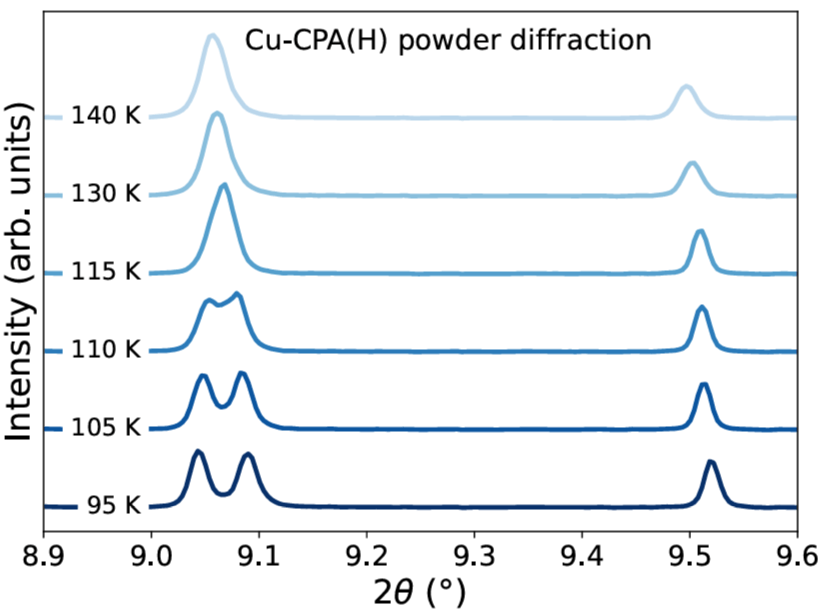
Recently, we realized that a coordination compound Cu-CPA hosts two distinct spin ladders. Now using neutron spectroscopy, we learned that remarkably, both of them lie close to a rare and intriguing regime — the isotropic case, between the limits of coupled dimers and spins forming extended one-dimensional chains. Further, the material is also extremely soft, with organic frameworks within the crystal having different ways of arranging themselves. This poses the question of whether the characteristic emergent magnetic excitations are altered via the presence of lattice vibrations or vice versa.

To understand this interplay, we probed both magnetic and elastic excitations and learned that the spin dynamics are not isolated from the crystal lattice, but instead are strongly coupled to its vibrations. Have a look at our preprint on arXiv to learn more about this effect and its implications.

Kagome Layers Far Apart

The two-dimensional kagome lattice with S=1/2 spins is a theoretically well-established way to realize a quantum spin liquid. However, all real materials are more complicated due to additional interactions and impurity effects. Up to now, all studied materials had only one spacer layer between the kagome planes, making it hard to fully decouple the layers and disentangle the inter- and intra-layer contributions to the experimental observations. We have recently studied a new material – averievite, where two spacer layers are present between the kagome planes, and have found that depleting both layers of magnetic ions is key to achieving a fully dynamic ground state. Learn more about it at https://arxiv.org/abs/2504.20871

Solid-State NMR Capabilities Coming to PSI

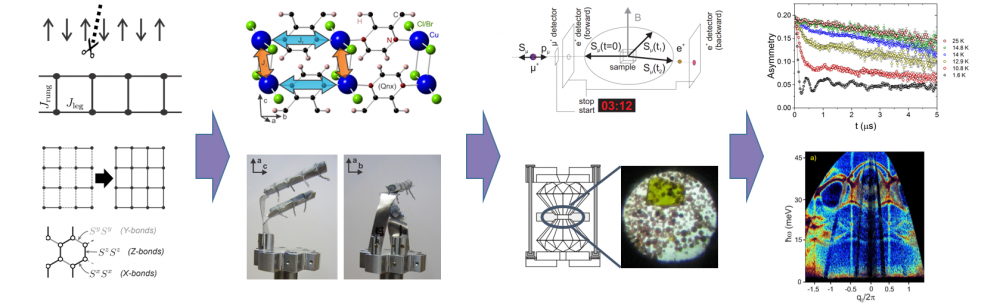
Nuclear Magnetic Resonance (NMR) is a key tool in solid-state physics. The spectrum measurements allow the determination of intrinsic, site-dependent susceptibility, and the relaxation of the polarized nucleus provides information about the dynamics of materials. We have recently been awarded an R’EQUIP grant from the Swiss National Science Foundation to set up an advanced NMR laboratory, where the key strengths of NMR will be amplified by ultra-low temperatures as well as high and sweepable magnetic fields. The lab will be built in the Quantum Matter and Materials Center (QMMC), currently under construction on our west campus.

Reaching Balance in Cuprates

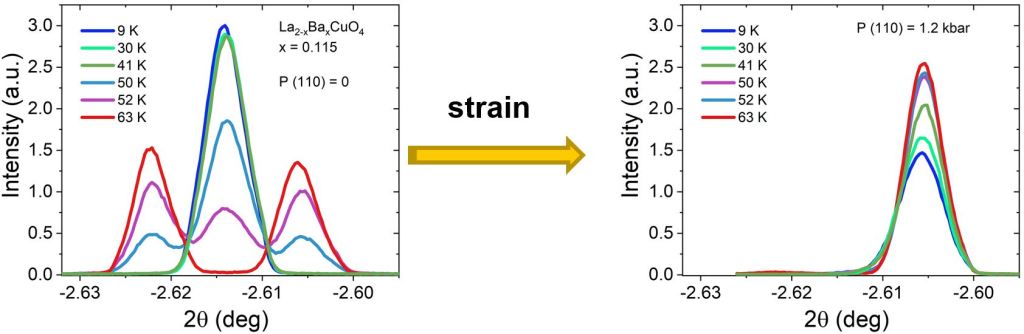
In many high-temperature superconductors, different electronic phases can compete or coexist with the superconductivity. We have recently used uniaxial pressure combined with hard X-ray scattering to tune and understand these phases in an archetype cuprate material. We have found that we can fine-tune the charge order to enable maximum superconducting transition temperature.

Have a look at our paper for more details.

Where is the background coming from?

Often the interesting experiments with neutron scattering come down to measuring weak signals due to low scattering cross-section. Moreover, these signals can be dwarfed by the background. Nowhere it is more acute than in the experiments involving high-pressures, where an already small sample needs to be placed in a bulky pressure cell.

To understand and mitigate this problem, we have been working with the neutron optics group at PSI to perform neutron ray-tracing simulations to understand the exact sources of the background and design neuron-absorbing structures to be printed with additive manufacturing methods. With several ongoing projects underway, there is an early report of one of the tests: https://www.sciencedirect.com/science/article/pii/S0168900224005606

Two ladders instead of one

Low dimensional systems are among the prime places to look for interesting emergent magnetic behavior in quantum systems. We have recently been studying a metal-organic coordination compound – (C5H9NH3)2CuBr4, or Cu-CPA for short, where magnetic properties are dictated by the one dimensional ladders of S=1/2 copper ions. Surprisingly, we have found that in fact there are two distinct ladders and not just one as was previously assumed. To learn more about the structure (and a cool isotope effect), have a look at the preprint: https://arxiv.org/abs/2404.08274

High Pressure Workshop at PSI

This fall, on the 22nd of November we will be hosting a workshop of all-things-pressure at PSI. The workshop is aimed to foster collaboration of researchers in Switzerland and the surrounding region using high-pressure to study various fields of physics, chemistry and material science. The talks will cover physics accessed by extreme conditions as well as the development of techniques and devices that enables them. Find out more here and hope to see you at PSI!

Designing Cuprate Phase Diagram

The various ground states in cuprate superconductors are finely balanced, with only a small energy differences separating them. It was recently found that using uniaxial pressure the balance can be tilted away from stripe order and towards superconductivity in the archetypical cuprate Ba-doped La2CuO4. We used our new uniaxial pressure device on a hard X-ray beamline at DESY to uncover how the different quantum phases are controlled by modifying the underlying crystal structure between orthorhombic and tetragonal phases. Find out more in our preprint:
https://arxiv.org/abs/2302.07015